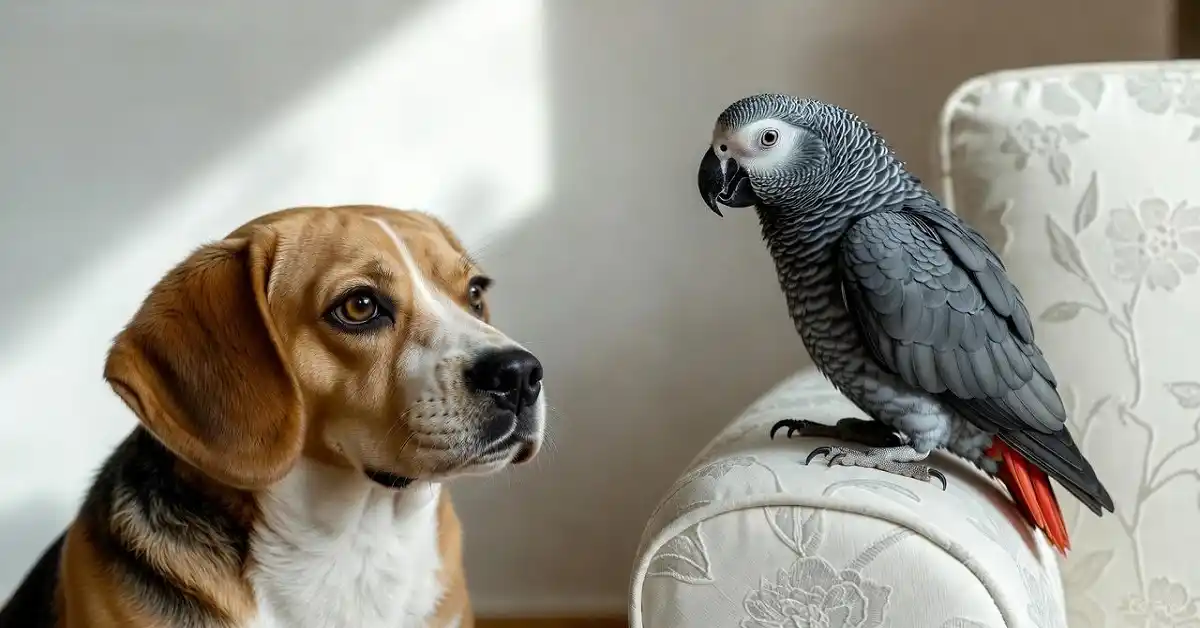

Living with both a dog and a pet bird can feel stressful—especially if your dog has a natural prey drive.
The fear of barking, chasing, or even harming the bird makes many owners anxious.
But the truth is… you can train your dog to be around pet birds safely.
With patience, structure, and the right techniques, dogs and birds can coexist peacefully—even bond.
This guide breaks down exactly how to train your dog to be around pet birds, step-by-step, using expert-approved behavior science.
To train your dog to be around pet birds, start with distance desensitization, reinforce calm behavior, use controlled introductions, and always supervise interactions. Keep birds secured during early sessions, reward positive responses, and gradually reduce distance as your dog learns to stay calm.
How to Train Your Dog to Be Around Pet Birds (Full Step-by-Step Guide)
1. Understand Your Dog’s Prey Drive First
Some breeds (Terriers, Hounds, Shepherds) naturally chase small animals.
This doesn’t mean coexistence is impossible—it simply means training must be structured and consistent.
What to observe:
Intense staring
Whining, pacing
Tail stiffening
Fast breathing
“Pointing” posture
If your dog shows these signs, start with longer distance and slower training progression.
Your dog’s instincts are not “bad”—they just need proper redirection and controlled training.
2. Create a Bird-Safe Environment Before Any Training
Your bird must be fully protected during all early training sessions.
Essential safety setup:
A sturdy cage with secure locks
A high placement out of dog’s reach
A pet gate or barrier between rooms
Avoid open-door access
Your goal: eliminate any chance of accidental harm while building trust.
3. Start With Distance Desensitization Training
In this phase, your dog learns that the bird is “no big deal.”
How to do it:
Keep your dog on a leash several feet away from the bird.
Observe your dog’s reactions.
Reward any:
Calmness
Soft eyes
Relaxed posture
Increase distance if your dog becomes tense.
Duration:
5–10 minutes per session, 1–3 times per day.
Calm behavior earns rewards; reacting means increasing distance.
4. Teach Strong Obedience Commands
Your dog must reliably respond to:
Sit
Stay
Leave it
Focus/Watch me
Come
These commands become your safety tools.
Training tips:
Use high-value treats
Practice in quiet areas first
Add bird sounds later for realism
Once these commands are solid, your dog will be ready for supervised introductions.
5. Controlled Introduction With Barriers
This is where true coexistence training begins.
Steps:
Place the bird in a secure cage.
Keep the dog on a leash.
Allow them to see each other—but with:
Distance
A barrier
Reward the dog heavily for calm behavior.
What NOT to allow:
Barking
Lunging
Intense staring
If these occur, calmly redirect with “Leave it” and reward relaxation.
6. Reduce Distance Gradually (Slow is Fast!)
Once your dog can calmly sit near the bird’s cage, you can reduce space step-by-step.
Safe progression:
6 feet → 4 feet → 2 feet → 1 foot
Only reduce distance after several successful sessions
Never move closer if the dog reacts
Take days or weeks—not hours.
Successful coexistence is built on repetition, not speed.
7. Supervised Free Movement (Final Phase)
Only after weeks of calm cage-side sessions should you allow:
Bird out of cage?
Not yet.
Dog off leash?
No.
Safe version of this stage:
Dog on leash or long line
Bird securely inside cage
Very close distance allowed
Reward calm ignoring of bird
When both animals behave consistently, you can eventually attempt:
Advanced Stage:
Bird out of cage
Dog on leash
Extremely slow introduction
Continuous supervision
Many households reach peaceful coexistence—some even form cute interspecies bonds.
Additional Training Tips for Success
Use Positive Reinforcement Only
Punishment increases anxiety and prey drive.
Rewards create calm association with the bird.
Give Your Dog Plenty of Exercise
A tired dog is more:
Relaxed
Less reactive
Easier to train
Reward the Behavior You Want
Every calm glance = treat
Every relaxed sigh = praise
Avoid Free Access
Never leave the dog and bird alone—ever.
Training your dog to be around pet birds is absolutely possible—with the right strategy, patience, and structured steps.
By using positive reinforcement, distance desensitization, and safe introductions, you can build a peaceful, multi-pet home.